Vendors use immutable, air gapped and isolated almost interchangeably. They describe three different protections, and knowing the difference tells you what an attacker can and cannot do to your last good copy.
Immutable means it cannot be changed
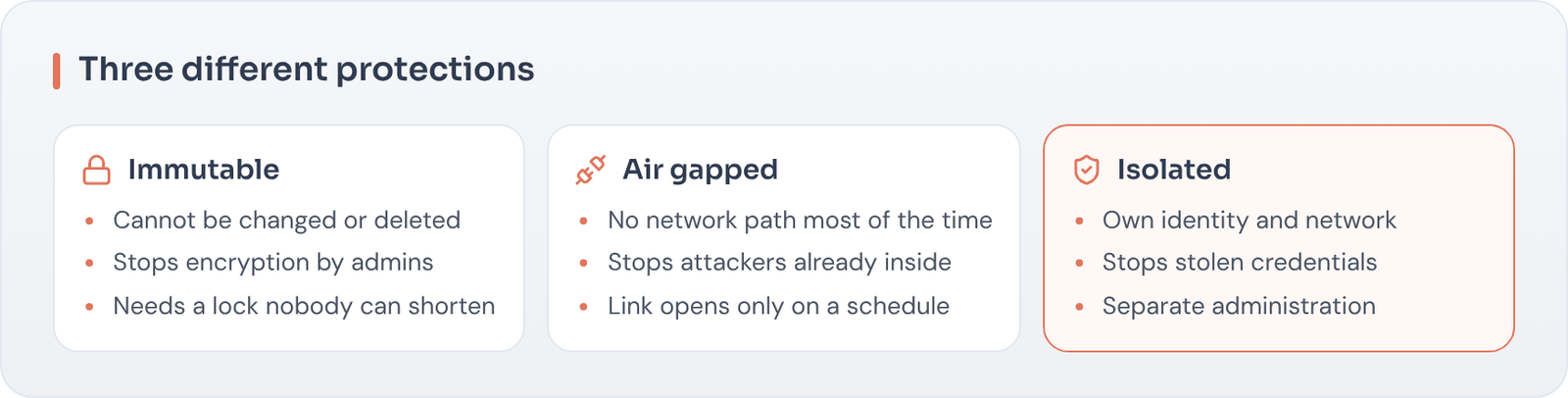
An immutable copy cannot be modified or deleted until its retention period ends. It protects against encryption and deletion, even by someone with administrator rights, as long as the lock itself cannot be shortened.
Air gapped means it cannot be reached
An air gap removes the network path to the copy, either physically with offline media or operationally with a link that opens only on a schedule. It protects against an attacker who is already inside your network.
Isolated means it is run separately
An isolated copy lives in an environment with its own identity, network and administration. Even if your main directory is compromised, nobody can sign in to the isolated environment with those credentials.
Questions to ask about your design
- Can anyone, including the vendor, shorten the retention lock?
- Is there a network path to the copy at all times?
- Does the copy use the same identity provider as production?
- When did you last recover from it?
Key takeaways
- Immutable stops changes, air gaps stop access and isolation stops stolen credentials.
- Most environments need all three for their most critical data.
- Prove each layer with a recovery test.
Not sure which protections you really have?
We assess your backup design independently and show where each layer holds or fails.