Your backup platform sees every change to your data, every day. Modern platforms from Rubrik, Cohesity, Commvault, Veeam and Dell use that vantage point to flag signs of ransomware.
What it looks for
- Sudden spikes in changed or new files
- Changes in file entropy that suggest encryption
- Mass deletions or unusual file extensions
- Changes in backup size or deduplication ratios
Making it useful
- Integrate alerts with your security operations centre.
- Tune thresholds to reduce noise.
- Define who responds and how quickly.
- Use alerts to identify the last clean recovery point.
Limitations
Anomaly detection is an early-warning signal, not a guarantee. It complements, not replaces, endpoint security, immutability and isolation.
A simple response playbook
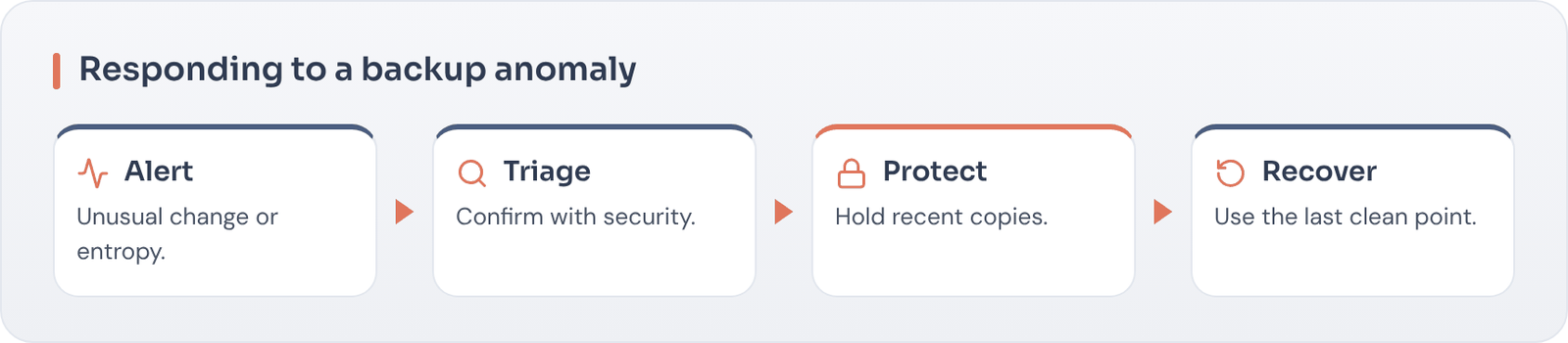
- Alert received: confirm whether the change is expected, such as a planned migration.
- If not expected, notify security operations and preserve current backups.
- Check endpoints and servers involved for signs of compromise.
- Identify the last clean recovery point for affected systems.
- Decide on containment and recovery steps with the incident lead.
Without a defined playbook, alerts are often noticed too late or ignored as noise.
Key takeaways
- Backup data is a valuable detection source.
- Alerts must reach the people who can act.
- Use detection to guide clean-point recovery.
Want an independent view of your recoverability?
Book a Recovery Readiness Call and we’ll help you turn assumptions into evidence.